
Which EHR Platform Is Right for Your Canadian Clinic? A Practical Comparison for 2026
If you’ve been running your clinic for any length of time, you have probably developed an opinion about your practice management software. Maybe you love it. Maybe you tolerate it. Maybe you’ve been quietly wondering whether something else would serve you better.
This post is for clinic owners across the spectrum of health disciplines in Canada who want a clearer picture of what the current platform options actually offer, especially as more of them start integrating AI tools into their workflows. Whether you’re a mental health group practice owner, a physio clinic, a multidisciplinary team, or an RMT running a small team, the right platform depends on more than features. It depends on your size, your billing complexity, your team structure, and where you want to be in the next three years.
I want to be straightforward with you: I think Jane App is the strongest all-around option for most Canadian group practices and multidisciplinary clinics. But I also think the landscape has gotten more interesting, and some owners are at a stage or scale where a different tool genuinely fits better. So let me walk you through what I am seeing.
The Jane App Reality in 2026

Jane App was built in Canada, and it shows. It’s PIPEDA, HIPAA, PHIPA, and GDPR compliant. It has multi-practitioner scheduling, insurance billing, telehealth, a client portal, and a genuinely strong support team. It recently earned a Silver Stevie Award for customer service (which is one of its best features in my mind). For a clinic with two or more practitioners across any health discipline, it remains the most complete platform available to Canadian owners.
On the AI side, Jane has launched its AI Scribe feature, which generates clinical chart notes from live session recordings or dictated summaries. One of the important points about this is that the Scribe is built entirely within Jane's environment and patient data is never used to train AI models. For therapists who have been nervous about what AI actually does with their clients' information, this matters. You aren’t sending sensitive session content to a third-party consumer AI tool.
Here’s a bit more. As Jane has grown, so has its pricing structure. For a solo practitioner or a very small clinic, the cost-per-practitioner model means fees climb quickly as you add team members, especially if you want features like Scribe or group bookings for couples. Some owners who have been with Jane for years have noticed that certain features they never use are being added while the features they actually need develop more slowly. That frustration is real, and it’s worth naming.
If you are running a clinic with three or more practitioners, billing extended health benefits, and planning to grow, Jane is still the safest, most scalable choice in the Canadian market. If you are running a smaller operation and the cost is becoming a strain, there are alternatives worth considering.
Owl Practice: Built for Mental Health
If your practice is exclusively mental health and you have been feeling like Jane is more platform than you need, Owl Practice is worth a serious look. It was designed with therapists in mind, and that’s evident in the charting structure, the intake process, and the way it supports group supervision and clinical notes.
Owl Practice is Canadian-built and PIPEDA compliant. It doesn’t have the same breadth as Jane for allied health or multidisciplinary clinics, but for a mental health group practice with two to six therapists, it offers a leaner, purpose-built experience at a price point that often competes well.
If your practice will always be exclusively therapy and counselling, this one deserves a proper trial.
Noterro: For Allied Health Clinics Watching the Budget
Noterro is a Canadian-friendly platform that has built a following among RMTs, chiropractors, physiotherapists, and acupuncturists. It runs approximately 30 to 50% cheaper than Jane across comparable tiers, and it includes an AI note-taker in the base plan rather than as an add-on.
The trade-off is that Noterro is not designed for complex group practice management. It works well for a solo practitioner or a small team of allied health practitioners who don’t need multi-location management, robust team reporting, or insurance billing at scale. If you fit that description and your Jane bill is causing friction, Noterro is worth looking at.
SimplePractice: Know What You Are Getting
SimplePractice is widely used in the United States and you’ll see it recommended in a lot of general therapy business content (and starting to be suggested for Canadians). The interface is clean and it has solid features for solo and small group mental health practices. The AI note-taking add-on is functional.
The challenge for Canadian owners is that SimplePractice was built around the American insurance model. Canadian billing workflows, extended health benefits, and the specific documentation requirements of Canadian regulatory colleges are not where its development focus has been. If you are private pay only and running a small practice, it works. If you need Canadian billing functionality, look elsewhere first.
The AI Feature That Matters Most Right Now
Across all of these platforms, the AI feature generating the most interest is the AI scribe, which generates clinical notes from session recordings or dictation. This is genuinely useful for reducing the administrative load after a full day of sessions.
Before you adopt any AI scribe tool, there are two questions to answer. First, does the platform keep your data in a compliant, closed environment, or is it sending recordings to an external service? Second, what does your regulatory college say about informed consent for recording? The requirements differ by province and discipline, and you are responsible for knowing yours before you enable this feature for your clients.
Jane has been explicit that its AI Scribe does not use patient data to train its models and that it is built entirely within Jane's PIPEDA-compliant environment. That is not true of every AI tool being marketed to clinic owners right now, so read the fine print before you record a session.
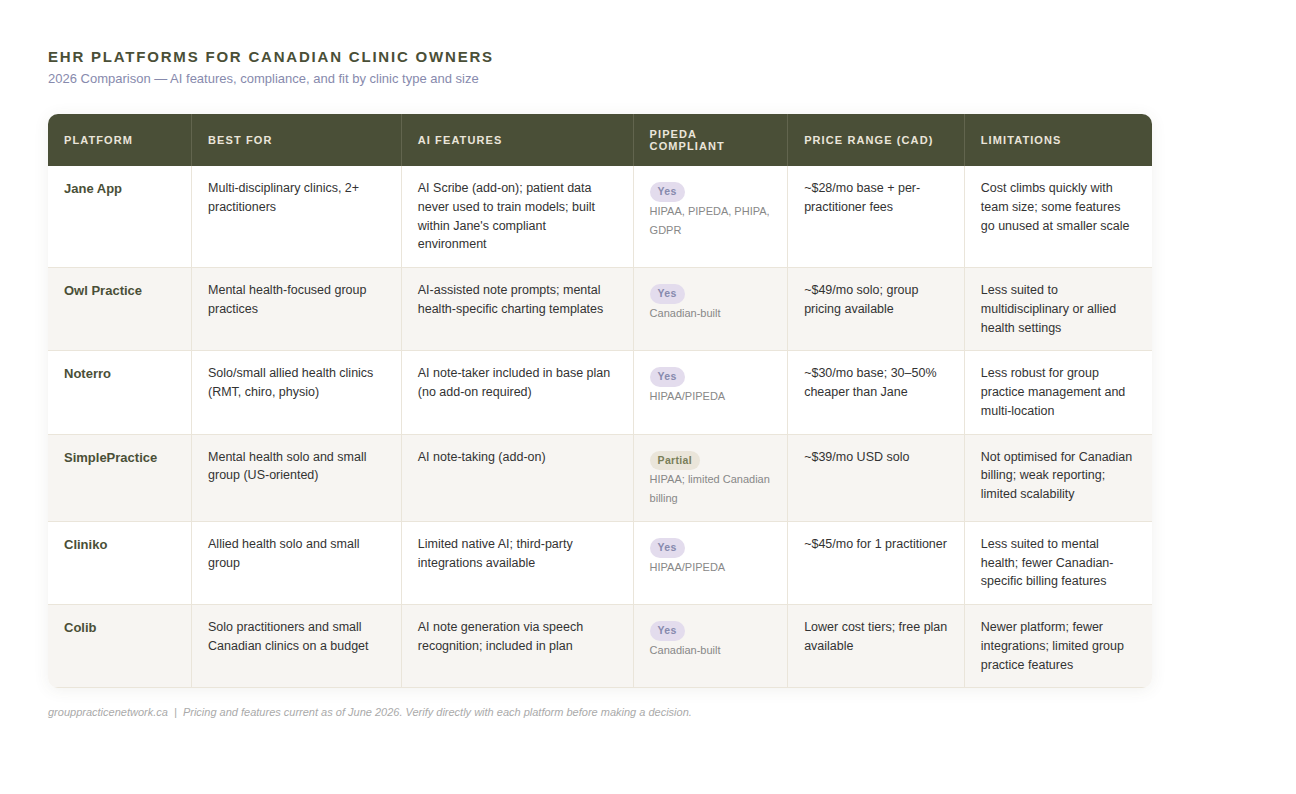
A Quick Reference by Clinic Type
Rather than tell you which platform is best in the abstract, here is how I would think about it based on where you are.
The Bigger Picture
Your EHR platform is a foundational system. Changing it mid-stream is disruptive, expensive in time, and often emotionally costly for a team that’s already learned one way of doing things. So while it’s worth evaluating whether your current platform still fits, it’s also worth doing that evaluation carefully rather than reactively.
If your platform frustration is really about how the platform is set up rather than the platform itself, that could be a systems and training problem. I see this often in coaching. A practice owner feels like Jane is not working, and when we actually dig in, the issue is that no one has ever built out the charting templates, the automated reminders aren’t configured, or the reporting tools have never been explored. The software has more capacity than they are using or using well.
If that resonates, before you switch platforms, spend two hours with your current system's support team or documentation. You may find the tool you need was already there.
And if you want to think through what your systems actually need at this stage of your practice, that is a conversation worth having. Platform selection and systems architecture are part of what I work through with clinic owners inside the Group Practice Connection and in individual coaching. The right tool is only as good as the structure around it.
